“I do not merely hear a melody. I hear where I have been, who I was, and what the music is becoming in that exact moment.”
The question beneath the question
INTERVIEWER: When you say that you love Yoko Miwa’s “Flood of Tears,” what do you mean by love?
DAVID: It is more than admiration. I can listen repeatedly and still be caught by it. I especially love the piano and bass lines - the way they return, change, and seem to mean something slightly different each time. Around 3:15 to 3:30, something in the passage becomes almost unbearably moving to me.
INTERVIEWER: That distinction matters. David is not describing a song that merely pleases him. He is describing recognition: the feeling that a piece of music knows something about him before he has found words for it. The emotional force comes not from a single melody alone, but from the relationship among memory, expectation and change.
In David’s listening, repetition is never passive. He remembers the earlier phrase while simultaneously hearing how Yoko reshapes it. A bass note moves; a chord is voiced differently; an accent arrives a fraction earlier or later; a line rises when it might have settled. The listener is given enough continuity to feel oriented and enough alteration to feel discovery. That combination - familiarity without predictability - is central to David’s musical life.
The first musical home
INTERVIEWER: Where did that way of listening begin?
DAVID: My first record was Dave Brubeck’s “Take Five,” with “Blue Rondo a la Turk” on the other side. I received it in 1961, when I was four and a half. My parents gave it to me because I was already in love with the Time Out album. But my favorite composition on that record was “Strange Meadow Lark.” I bothered my parents to play the album constantly.
That childhood detail is not incidental. Long before David possessed a technical vocabulary for harmony or form, “Strange Meadow Lark” taught him an emotional grammar. Its piano opening is spacious, intimate and searching. It establishes a private interior world and then allows a larger rhythmic life to emerge from within it. Stillness becomes motion without losing its original tenderness.
David was therefore learning two things at once: what jazz could do, and what a piano could mean. He later taught himself at the Chickering studio grand his mother had given him, listening repeatedly to Stevie Wonder records until he could locate the notes and chords. His ear developed through return and comparison. Every repetition became an act of investigation: What remained? What changed? Where did the harmony pull away, and how did it find its way home?
“The repetition gives David security; the variation gives him revelation.”
Szczecin: when a lifetime entered the room
INTERVIEWER: You once heard “Strange Meadow Lark” in circumstances that overwhelmed you. What happened?
DAVID: In February 2018, I was at Radio Szczecin in Szczecin, Poland. During a soundcheck, Darius Brubeck began playing “Strange Meadow Lark.” It brought me to tears, although at the time I did not understand why.
Psychologically, the absence of preparation is important. This was not a concert moment announced by a title and surrounded by applause. It was a soundcheck. David had no time to put up the ordinary intellectual frame of “now I am going to hear a meaningful composition.” The music simply appeared. Recognition reached the body before explanation reached the mind.
In that room, several versions of David converged. There was the four-year-old child in Germany listening to Time Out with his parents. There was the boy who inherited his mother’s piano and learned by ear. There was the Army Russian linguist and later infantry officer whose life would be shaped by travel. And there was the adult filmmaker in Poland, working on the Brubeck story that would become Playing the Changes - Darius Brubeck and help define The Real Jazz Ambassadors.
Darius was not simply another pianist performing a standard. He was the composer’s son, making the music physically present across generations. A composition associated with David’s earliest sense of self had arrived inside his adult purpose. The tears may have contained nostalgia, but nostalgia is too small a word. They carried continuity, gratitude, loss, recognition and arrival.
Why the passage in “Flood of Tears” is so powerful
INTERVIEWER: What does Yoko do in the passage around 3:15 to 3:30 that reaches the same emotional territory?
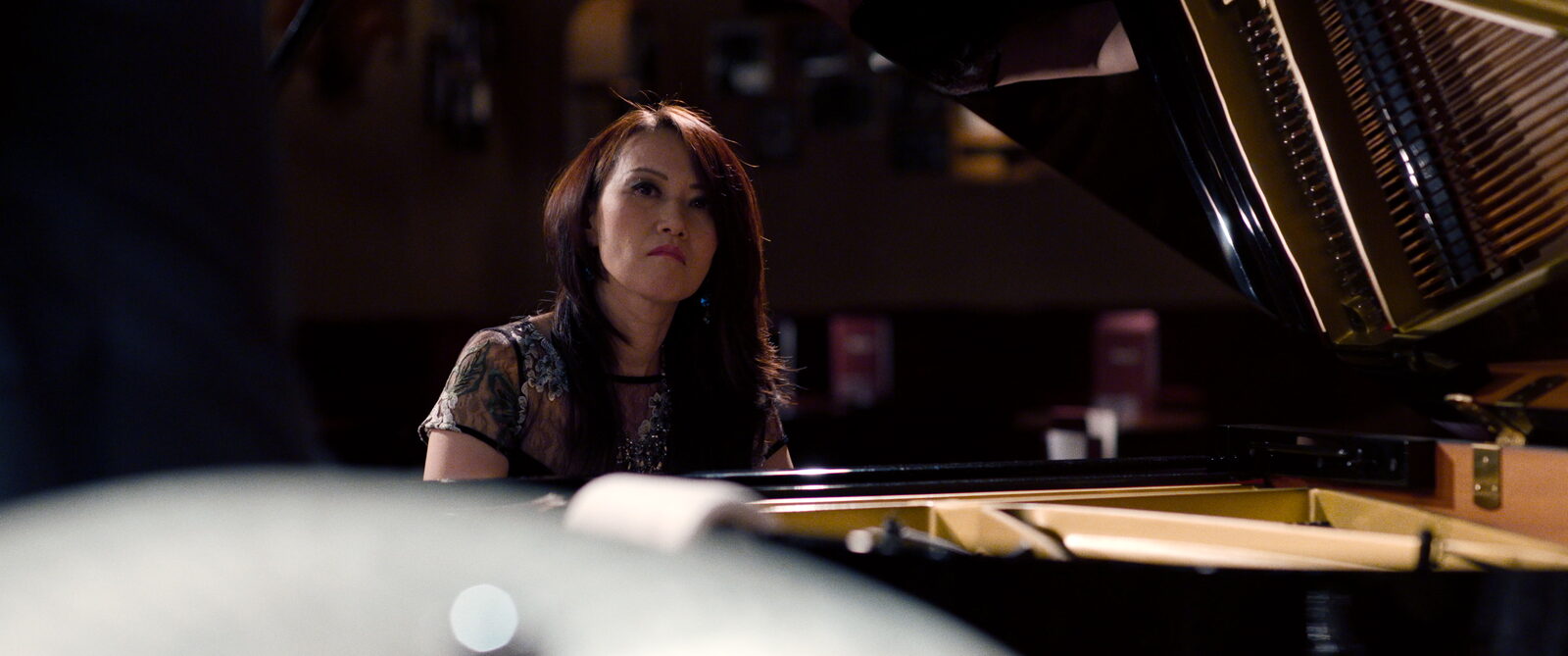
The attached performance places the passage at roughly 112 beats per minute. Across approximately seven measures, the trio repeatedly establishes and then revises its emotional ground. Yoko’s piano line pushes forward while Will Slater’s bass supplies a foundation that is never merely static. Scott Goulding’s rhythmic presence gives the movement a bodily pulse without reducing the harmony to something mechanical.
At first, the phrase sounds as if it is beginning a journey rather than announcing a conclusion. The piano reaches while the bass redirects the harmonic weight underneath it. A lower, more stable area briefly appears, but Yoko continues searching above it. That is the first emotional contradiction: the ground may be present, yet the speaker is not ready to rest.
The material then returns in altered form. The listener recognizes its family resemblance, but the changed bass support means it cannot feel identical. Piano and bass behave like two minds in conversation. One proposes, the other reframes. One rises, the other pulls downward. Their independence creates friction; their attentiveness to each other creates intimacy.
Near the center of the passage, the ensemble swells and the bass rises before dropping into a more decisive lower arrival. This resembles the sensation of maintaining emotional control until the body can no longer contain the accumulated pressure. Yet the release is incomplete. Yoko continues to color the harmony above the apparent landing point, and the phrase soon reaches forward again instead of closing with a comfortable full stop.
That refusal to manufacture a tidy resolution is crucial. David is moved by music that tells the truth about feeling: an experience can resolve enough for us to continue without being completely finished. “Flood of Tears” does not simply portray sorrow. It portrays the mind living through sorrow - remembering, resisting, yielding, reorganizing and continuing.
Why the piano-bass relationship matters
INTERVIEWER: Why do you focus so strongly on the piano and bass lines?
DAVID: I like the way the lines vary. I hear the pattern, but I also hear that it does not come back exactly the same way.
That answer reveals David’s central listening instinct. He does not hear the bass as background support. He hears it as meaning. When Will changes the note beneath a related piano figure, he changes the emotional interpretation of that figure. The same melodic contour can sound hopeful, suspended, wounded or newly determined depending on the ground beneath it.
David’s ear is therefore following at least three layers at once: the remembered shape of the piano idea, the changing harmonic foundation supplied by the bass, and the delayed destination created by the trio as a whole. Repetition gives him orientation. Variation rewards his memory. Delayed resolution keeps him emotionally involved.
This also explains why piano remains his natural center of attention. The instrument can sing and accompany itself; it can state a vulnerable melodic thought while simultaneously revealing the harmony that supports or unsettles it. In Yoko’s hands, those layers do not feel like an academic demonstration. They feel like consciousness speaking to itself.
Why Yoko Miwa is his favorite pianist and composer
INTERVIEWER: Is this response unique to “Flood of Tears”?
DAVID: No. Many of Yoko’s own compositions affect me this way. That is why she has become my favorite pianist and composer.
The distinction between favorite pianist and favorite pianist-composer is significant. David admires virtuosity, but technique alone does not secure his deepest loyalty. He responds to an artist whose original compositions repeatedly create an emotional architecture he recognizes: lyrical clarity, harmonic movement, strong internal pulse, conversation among the instruments, and themes that return transformed rather than merely repeated.
Yoko’s playing combines discipline with emotional openness. Her compositions allow David to anticipate structure without predicting experience. They invite close listening, and close listening makes the music more rewarding rather than less mysterious. That is exactly suited to a man who once spent hours replaying records to discover their notes and chords and who later traveled across countries to hear musicians reinterpret familiar material in their own voices.
His connection to Yoko is therefore both musical and biographical. Her work extends the piano language through which he first understood jazz, while her journey from Kobe to Boston reflects his belief that jazz crosses borders, languages and cultures. Producing Yoko Miwa: Fadeless Flower is not separate from this attachment. It is his attempt to preserve and communicate the source of it.
And then, a voice: Mikayla Shirley
INTERVIEWER: Recently you have spoken with similar excitement about vocalist Mikayla Shirley. What changed?
DAVID: With Mikayla, I think I may have found my favorite vocalist.
David summarizes the critical comparison this way: while Mikayla brings modern energy, her voice possesses the raw athletic power associated with Ella Fitzgerald, the emotional honesty associated with Billie Holiday, and the deep, elastic vibrato associated with Sarah Vaughan. Those are formidable points of reference, but what matters most to David is not resemblance for its own sake. It is the union of physical command and emotional truth.
That attraction follows the same pattern found in his response to Yoko. David wants to hear an artist fully inhabit the material. Athletic ability matters because it expands what can be expressed; emotional honesty matters because ability without vulnerability would leave him outside the experience. Mikayla’s voice offers both immediacy and depth - youthful energy carrying echoes of the vocal tradition David has loved throughout his life.
Yoko and Mikayla reach him through different instruments, but for related reasons. Both make technical control feel like emotional freedom. Both can honor tradition without becoming trapped inside imitation. Both create the impression that the music is being discovered now, even when its deepest roots stretch across generations.
The answer
INTERVIEWER: So why does David E Richardson Jr. love “Flood of Tears” so much?
Because it speaks in the musical language through which he first learned to recognize himself. It begins with the intimacy of piano, trusts repetition without surrendering to sameness, allows the bass to transform the emotional meaning of each returning idea, and moves toward resolution without pretending that human feeling can always be neatly completed.
It recalls the searching beauty of “Strange Meadow Lark” without copying it. It activates the listening habits formed beside his parents’ record player and refined at his mother’s piano. It resonates with the tears that came unexpectedly at Radio Szczecin when Darius Brubeck caused childhood memory and adult vocation to occupy the same room.
Most importantly, it continues that story rather than merely reminding him of it. Dave Brubeck gave David an early musical home. Darius reopened its door in Poland. Yoko Miwa has built new rooms inside it - rooms shaped by her own life, compositions and voice. Will Slater and Scott Goulding make those rooms breathe through conversation. And now Mikayla Shirley brings a human voice into the expanding house.
David loves “Flood of Tears” because he does not experience it as an object outside himself. He experiences it as memory becoming movement. The music recognizes where he came from, meets the person he became, and still leaves the future unresolved enough to invite him forward.